
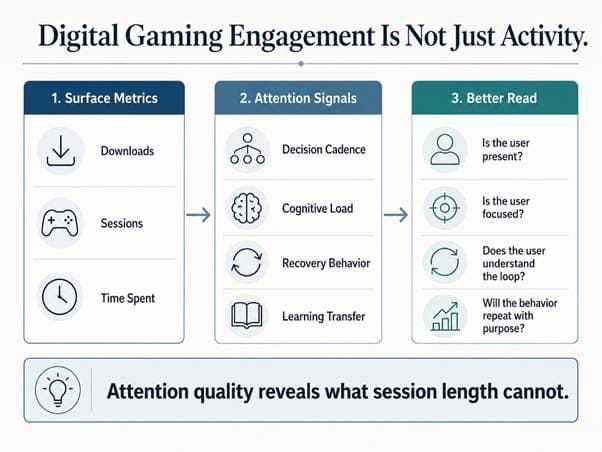
The metrics collected by digital gaming companies are easy to misread when the analysis stops at activity. Downloads, sessions, and time spent show that users arrived. They do not prove that users understood the experience or engaged with the content beyond surface-level interactions. That is why measuring user attention can be a better metric for determining whether engagement has substance.
That distinction changes the quality of analysis. Engagement is the relationship between focus, cognitive load, motivation, and repeated use. A 2024 open-access study on gamification, motivation, and cognitive load found that both motivation and cognitive load influenced learning engagement, with cognitive load showing the stronger effect in its model. That idea travels well into digital gaming: the most valuable experiences are not always the loudest or longest, but the ones users can process and re-enter with confidence
Attention Under Real Decision Cadence
A useful way to study attention is to look at environments where decisions arrive in a steady rhythm. A relevant example would be this crypto poker site. It offers a wide variety of familiar poker formats, such as Texas Hold’em, Omaha, Omaha Hi/Lo, tournaments, and Sit-and-Go play. The value of poker games as an example is their decision cadence. A player is not merely scrolling or watching. The experience asks for waiting, observing, choosing, adapting, and resetting attention from one hand to the next under shifting information.
In that context, crypto poker helps show how payment method, device choice, game format, and mental focus can sit inside the same product experience. For analysts, the broader lesson is that attention becomes visible when a product asks users to stay mentally present across repeated moments, rather than simply remain logged in.
The same point becomes clearer in Master the Mental Game: Poker Psychology Explained. The video focuses on poker psychology through concentration, patience, pressure control, bluffing psychology, tilt control, level thinking, and player pattern recognition. This provides a visual example of attention as behavior: the user notices information, filters distraction, regulates emotion, and separates one decision from the next.
Why Session Length Is Too Blunt
Session length is an attractive metric because it is easy to measure and report, but it does not tell the full story. A 20-minute session may show deep concentration, light browsing, social waiting, confusion, or simple habit. The session length may be the same, but the behavior underneath is not.
Digital gaming makes this especially important because different models ask for different kinds of attention. A puzzle game may reward pattern recognition. A competitive game may depend on social timing and fast reaction. A poker-style format compresses long pauses and brief decision windows into one session. In each case, attention is shaped by rhythm, not just duration.
| Signal to read | What it reveals | Why it matters |
|---|---|---|
| Decision cadence | How often users must observe, choose, wait, or adapt | Shows whether engagement is passive or mentally active |
| Cognitive load | How much information users must process at once | Explains whether complexity supports or weakens clarity |
| Recovery behavior | How users respond after surprise, delay, or a difficult moment | Shows whether attention stays stable |
| Learning transfer | Whether users apply understanding in later sessions | Suggests engagement is becoming more durable |
The table points to a simple truth: attention is not one metric. It is a pattern across moments. A product can create frequent interaction without deep focus. Another can create shorter sessions that reveal a stronger understanding. This is why surface-level engagement can mislead if it is read without behavioral context.
What Attention Reveals About the Model
Attention shows how well a platform explains itself. When users understand what to do next, they will feel more comfortable using a product. When the learning curve feels coherent, complexity can become part of the appeal. When feedback arrives at the right moment, users can adjust without feeling lost.
This matters because gaming models often grow through repetition. The first session introduces the loop. Later sessions reveal whether the loop has clarity and pacing. Strong engagement depends on how well those pieces work together. If the product asks for a lot of focus too early, users may not have enough context. If it asks for too little, the experience may feel thin. If it teaches gradually, attention can deepen.
A sharper analysis therefore asks better questions. What does the user need to notice? How quickly do decisions arrive? What does the product teach without overexplaining? Where does attention become active, rather than automatic? These questions help separate basic activity from meaningful participation.
The Metric Beneath the Dashboard
For finance and operating teams, the takeaway is to read engagement through the quality of focus. A healthy digital model brings users in, gives them enough clarity to understand the loop, enough rhythm to stay involved, and enough variation to return with purpose. That is why attention deserves a place beside traffic and retention. It explains what users are doing with their minds, not just what the dashboard records, a point reinforced by a Frontiers in Psychology meta-analysis on gamification in education.
